A two Edged Sword
One of the central aspects of hard SF has always been the exploration of the effect technology has on society. In this post I'll look at some technologies that are united in their rapid development and difficulty of control if they are used for nefarious purposes. All of them are technologies that will doubtless continue to expand due to economic and social factors, and that it would be, in many cases, impossible for a government to control. All of them exist or will exist in the present or near future, allowing their effects to be more obvious, and more helpful for world building purposes.
3D Printers
3D printerest are the closest we are likely to come to Star Trek's Replicators, and although they cannot yet provide us with a steaming cup of Earl Grey, they are nevertheless amazing pieces of technology. Very simple in concept the 3D printer uses a laser or electron beam to melt particles of metal or plastic together in complexed three dimensional shapes that would be difficult or impossible to create with conventional techniques. Although there are problems with strength, resolution, and speed, the 3D printer offers a way to produce complexed or one-off designs with little effort, and has advantages when a blend of alloys or plastics is needed. Although limited to thermoplastic and metal, a 3D printer can produce any piece of technology compatible with them, and therein lies the problem.
In 2012 the open source organisation Defence Distributed disclosed the plans of the Liberator, the worlds fist 3D printed gun; a single shot pistol crafted from plastic and firing .38 ACP. Then in 2013 the Texas based company Solid Concepts demonstrated a 3D printed M1911, the only part of which was not manufactured on a industrial 3D printer being the springs, as these are impossible to produce using that technique. While the liberator is not much of a weapon - despite the additional difficulty of detecting a plastic gun this is no advantage for hypothetical assassins as the bullet is still easily detectable - the printed M1911 is a true weapon.
Leaving aside the debate over if civilians should have access to any weapon they want, the potential problem is clear. A 3D printer that can produce car parts can equally easily print a working gun, even a machine-gun. The only difference is in the commands the machine is given. Nor is it only guns; missiles, grenades, mines, torpedoes, and armed UAV/UGVs. Although a great deal of expertise would be required to design the weapon sin the first place, their dissemination would be almost impossible to control, and far easier than trying to distribute physical weapons. Potentially, every workshop equipped with a 3D printer is the basis of an arms factory, something that will only become more true as the printers gain the ability to print more materials in more accurate patterns.
And there is very little that the governments of the world can do. 3D printers have far to great an application in legitimate business for them to be outlawed, quite aside from the political impossibility of such a move. Just as herculean a task would be restricting the distribution of plans or information, and this might well prove to be a futile effort.
In a futuristic 'Verse 3D printers are likely to be widespread, given their rapid development and adoption. In space or on a colony world especially the flexibility of a 3D printer could enable much more rapid Human expansion. Also, the nature of 3D printers makes a von Neumann device possible, not as a single 'organism' but as a colony of symbioses; these could be landed on an asteroid, and years later, have converted it into a spacecraft. Militaries might not carry supplies with them, only printers and feedstock. Trade in digital plans would be brisk, and might be one of the most profitable forms of smuggling. If you postulate a ''Verse in which transferring the plans over the internet is too dangerous, the possibility of a 'Han Solo' smuggler occurs along with a host other SF character types.
Further yet into the future and SF territory are 3D printers capable of reproducing biological material. The implications for medicine would be unparalleled, with almost any trauma curable. However, if it can produce a human cell, it can produce a deadly engineered disease or bioweapon. It is important to note that due to the complexity of cells, the wholesale printing go body tissue is unlikely. Instead the printer will create a single cell that is then grown into a replacement organ, perfectly matching the patients genetic and immune makeup.
Drones & Autonomous Vehicles
Like 3D printed guns small drones - typified by the UAV 'quadcopters' - are a rapidly exploding technology that has caused some alarm in society at large. Although almost unheard of a realitivly short time ago, UAVs are now readily available, ranging from small toys not larger than an hand, to industrial models capable of operating without supervision and carrying payloads. Many of the 'hobby' models can be controlled via a smartphone, while the more advanced models used onboard computers, GPS, and a computer based control system similar to that used with military versions.
The most common complaint about small drones is their invasion of privacy. Equipped with a small video camera the drone is a perfect snoop, overflying property and peering through windows. Another, more deadly concern is that of a drone flying into commercial airspace and causing a fatal accident. Although it seems unlikely that the small drones in use today threaten a passenger jet, smaller aircraft are definitely at risk, and the size of drones is increasing. More terrifying is the thought of their use as a weapon, carrying bombs or biological weapons, and acting in essence as low cost miniature 'cruse missiles'. A common theme in modern military SF has been the inclusion of weapons on small drones, most famously in the video game Black Ops II, and while this is unlikely for a while yet, they are still deadly impromptu weapons that most security forces would be hard put to combat.
The problem of control is similar to that of 3D printed weapons. There are so many legitimate uses that it is not possible to utilise an blanket solution, and given that the difference between a aerial mapping and attack drone is the payload, any security measures are going to be a nightmare to enforce. The problem will also increase as 3D printers become more capable; even if a license is needed to buy a drone it is no matter if you can simply print one off. Perhaps the biggest difficulty to overcome in this will be the printing of electronic components such as sensors and computers.
In the future or in a SF work drones will be smaller, faster, stronger, more silent, and more capable. They may also be joined by UGV, perhaps mottled to look like insects, along with aquatic variants. As electrons are miniaturised further, they may become effectively undetectable, posing a massive security risk for anyone with secrets to hide. More advanced AI will also enable them to act more independently; Skynet, anyone? In a SF 'verse drones will be yet another of a myriad technologies that will be juggled on a day to day basis to provide profit, security, information, and offensive ability.
Ubiquitous Surveillance
Ever since the invention of the internet, and even more so after the rise of social media, the amount of information available to the general public on any one individual has increased dramatically. Facebook alone provides a database that many intelligence agencies would have given their eye-teeth to own throughout history. Many so called 'smart' electronics in fact process little information, sending it across the globe to a supercomputer whose owners may or may not choose to respect your privacy. An uncountable number of photos exist on the internet, the result of ceaseless snapshots by smartphone users, and a wealth of data for any system capable of interpreting it. This is without considering increases in government surveillance; cameras, internet and communications monitoring, etc.
One of the things preventing the utilisation of this data is the limits of computer technology. Given the programs, computers, and access to the internet, someone could trace people through a city just by there appearance in the background of other peoples photos. A more ruthless and advanced tactic would be to hack into millions of smartphones, constantly utilising the data from cameras and sound-pickups. Even now the time is not far off when we will be able to walk down the street wearing something like google glasses, having them feed us information on every person we walk past.
That a society in which the barriers to using this wealth of information fully will be different to pour own is definite; the nature and extent of the change, however, is a question almost impossible to answer. Some SF authors, such as Arthur C. Clark and Stephen Baxter in their The Light of Other Days, postulated that unlimited information would abolish crime, and help usher in a near-perfect civilisation. While the proliferation of total surveillance may not achieve this, it is an interesting concept.
Because of the myriad possibilities of such a society it is impossible to comment on how it would effect a SF 'Verse. The effects would be closely entwine with the nature of the technologies used, and thus every 'Verse will be radically different. One important point to remember, however, is that even with quantum computing, searching vast masses of data takes time. Without a starting point a search for one person could takes years, so espionage, while more difficult, is not impossible. A good example of this is in Poul Anderson's novel The Stars are also Fire.
Fusion Reactors & Nuclear Proliferation
While this is a little on the SF side of things, no fusion reactors currently existing, it is a real problem. While a in theory fusion reactor in itself does not produce radioactive elements, or pose a nuclear threat, the actual fact is somewhat less rosy. Very few fusion reactions are aneutronic, that is, releasing less than 1% of their energy as neutrons. The most common candidates can release up to 80% as neutrons, meaning that the interior of any fusion reactor is quickly transmuted into unstable isotopes. If fusion reactors ever become so widespread that a terrorist organisation or rogue government could obtain one, they could not produce nuclear warheads without the uranium to enrich, but they could use it to make a dirty bomb; conventional explosives wrapped in a casing of highly radioactive material. One of these detonated within a city might render it uninhabitable, and kill thousands with radiation poisoning.
In the real world this scenario is an unlikely one. Fusion reactors are likely to be more complexed and expensive than fission ones, limiting their availability for a long time. In a SF 'Verse, however, the may be more widespread, and proliferation that could lead to fears of nuclear terrorism. This could be a great problem with small corporations mining the asteroids; if they found uranium and enriched it, none back on Earth would know.
Private Spacecraft
Although not unseen in SF this is a relatively new threat in the modern world. Anyone who has any scientific knowledge knows that even small objects at high velocity pack a lot of punch, and in space velocities are high indeed. With the proliferation of private spacecraft the real danger is that one of them might be used as a weapon, either by its owners, or by someone hacking into its systems. While most spacecraft cannot renter the Earth's atmosphere - and those that can decelerate to around of below Mach 1 even in the worst case - meaning they cannot effect anyone on Earth's surface. However, and impact in orbit could cause a Kessler Syndrome event, denying access to space for many years.
Once space is commercialised or colonised the danger is greater. A moon base, orbital habitat, or mining station is not protected by atmosphere, and even a low speed impact could kill everyone on board. More terrifying, a cargo ship transporting ore from the asteroids to earth could use it as impromptu kinetic warheads. Despite being inert, a dense limb of rock and metal is every bit as deadly as a nuclear warhead, and may be more difficult to counter. Only one tonne, travelling at a velocity of Mach five, has an energy of 1.5E9 J. Not quite nuclear standard, but change that to a five-hundred tonne asteroid chunk, and the atmosphere looses its shielding effect, pushing the impact energy up into the city destroying range.
Any future or SF society with widespread civilian access to space will have intense security measures. It is quite likely that if a spacecraft strays off its course, or does anything untoward, it may be summarily destroyed rather than have the risk it imposes. Even a suborbital transport could be effected by this, a last minute course change could see it slamming into a city rather than softly landing at a spaceport. And interesting plot for a SF thriller would be a terrorist group using hijacked spacecraft to bombard the Earth. Without a full scale nuclear defence system stopping a spacecraft or lump of rock going at interplanetary transfer velocity is almost impossible, so great for a cold war in space kind of setting.
Friday, 20 February 2015
New Look
I've decided to change the blog's aesthetics for no solid reason. I feel that the new design is more 'open' than the previous version, which I always felt was a little claustrophobic. Although, of course, that could just be me.
Anyhow, the blog has a new look. Hopefully it'll have some new posts to match over the weekend.
Free Blenderings: Golden Age SF Rockets
Classic Rocketships
For those denizens of the internet, who frequent Atomic Rockets and its ilk, are two spacecraft designed as 'God and Hienlein' intended.
Both meshes are un-detailed, but are pretty clean in terms of the lines, vertices, etc. so that if you wish to add any detailing it shouldn't be a problem.
Classic Rocketship
A4 Rocket
Saturday, 7 February 2015
SF Technology: Transport in a Future World
![]() |
| Yes, I want one too. |
Is that a plane? No, its...
What will the future actually be be like?(since in most cases SF = future) Although Hollywood assures us that the cars will be faster and the women wear less very little effort is ever spent on what life will actually be like in a hard SF or futuristic world. One aspect that gets little attention is transport. Of course, there are almost always flashy spaceships, but these are hardly the vehicle for getting to the office early Monday morning. To design a transport system for a 'Verse it is necessary to understand two aspects; the technical and the infrastructure. I'm not really qualified to talk about the latter - the organisation and needs of a railway system, for example - as I am about the actual technology, so I'll focus on that. There is one aspect however, that while not strictly technological, I will explore; the factors that shape the nature of a transportation system. Then I'll look at several SF transport systems, or variations of the systems we have now, and look at how they might be used or justified.
Inertia & Change
Society, like everything else, resists change. The universe as a whole seems perfectly content to potter along just as it is, and as a result is the annoying and sometimes disastrous phenomenon of Technological or Societal Inertia. Or, as it is often stated; 'if its not broken don't fix it'. Of course, this reluctance among society to change often has undesirable consequences, delaying the dissemination of better ethics, economics, medicine, politics, etc. And, perhaps surprisingly, technology. Sometimes it is not even a conscious resistance an may be the effect of purely economic considerations.
For example; train tracks. Long ago the Romans built bridges based on the width of their chariots, so that they would fit easily through the arches. Thus, hundreds of years later, when train tracks were built all over England, they had to be built to fit the same dimensions, or be unable to use the existing infrastructure. This problem continues today. Maglev or ground effect trains would be much more common if their use did not require substantial modification of existing tracks, tunnels, etc.
The same is true with any system, and brings up an interesting point. In a newly colonised world, a terraformed Mars, for example, this could be avoided. As there is no existing infrastructure, it would make sense to go the whole hog and build the best system, rather than the one that meshes most easily with what was being used before. So while Earth may always use physical train tracks, Mars or a planetary colony could have maglev as the norm. This should be kept in mind when world building; why are things the way they are? If you give this some thought your 'Verse will be all the better for it.
Advanced Transport
Although currently the realm of space enteprenures and of billionares, sub-orbital flight offers intriguing possablities for rapid, long distance transport of people and/or high value cargoes. Even with hypersonic aircraft - which may or may not ever proove feasable - travelling from one continent to the next is a long and tiring journy. Even crossing a country such as America in an airliner is an experiance few would hesitate to avoid. A sub-orbital transport, whether ballistic or aerodynamic, can cut tirp times drastically. A long-impulse ballistic flight from Europe to America could take as little as half an hour.
Cost is likly to be the single biggest factor preventing the use of such a system for a long while to come; if it was economical, I have no doubt but that the rich and powerful would travel in suborbital rockets, using them as the ultimate 'exeutive jet.' But as propulsion and materials technology improoves the cost comes down, and it is only a matter of time untill it is possable. The other biggest drawback is the effort involved. The craft, if ballistic is going to be around the size of a smallish surface-to-LEO transport - although with proportionally bigger payload - and will need a lot of fuel. This problem is most easily solved in a setting with plentiful electric power - simply electrolise water and pump it stright into the tanks as hydrogen and oxygen rather than storing large amounts of volatiles.
It is alos important to keep the history and background of your 'Verse in mind. A recently colonised planet, for example, might not have the expertise or resources to build aircraft. But if they have ISRU plants to produce rocket fuel, and have a lander, they have examples from which to copy. Thus on a colony world rockets might be more common than aircraft on long-haul flights, exepting those with massive cargoes. And on Mars, with its thinner atmosphere, aerodynamic flight may not even be possable, not to mention totally airless worlds.
Land transport in the real world is pretty much dominated by cars, and not only that, but cars that all follow the same basic design. Four wheels, IC engine, load-bearing frame, aerodynamic shell, etc. Only recently, with growing concerns over ecological impact, sustainability, and energy cost, have newer or alternative technologies to land transport been considered. Solar power, fuel cells, hydrogen, bio-fuel, there are a plethora of emerging power sources, along with composites for construction and computer for navigation and safty. But all these still feed into the four wheel design philosophy, and to add a little zest to a SF 'Verse authors may resort to more radical designs.
For a newly colonised or resource scarce world hovercraft are a good option, able to travel over land or sea at high speed. Similarly ground effect vehicles are spectacular but proven technology, as anyone who has seen this will know. Both hovercraft and wing-in-ground effect craft have the advantage of much greater payloads than conventional aircraft, while being far faster than any surface vessel. One with nuclear power could provide rapid transport over wide stretches of ocean or open land, and in the case of the hovercraft, need no expense runway or mooring area.
But even without going to these extremes you can fill your 'Verse with advanced vehicles unlikely to be widespread anytime soon. Cars with radioisotopic powered motors, for example, will never become legal on Earth, but might be acceptable in another culture or time, and would have unlimited range. Some artists have shown variable geometry cars in concept art, able to swivel upright and park in a third of the space of a conventional car, handy in the crowded megatropolis of the future. Cars without windows, but with the entire inside surface a HD colour screen could be more aerodynamic, crash-resistant, offer better views and more privacy. Two wheeled cars that balance precariously like a segway may look alarming, but might offer a turn of speed and manoeuvrability that police or armed forces could befit from. In fact, SF-ifying the cars of your 'Verse could be one of the easiest ways of planting it firmly in the future, as well as indicating the technology of the cultures and civilisations.
Ocean Transport
Ocean transport might seem at first to be a dead end for the SF writer, after all, not much has changed in the design of ships since the adoption of the diesel engine, and the design, like that of passenger jets, is perfectly optimised. For greater efficiency a new design must be employed, but given the economics of shipping there is no real push to develop new technologies compared to the aerospace market. Wave piercing, the use of turbine engines and water jets, are three newer features, but hardly SF. Submarines offer some possibilities, though. Say, a fast transport submarine, design to shuttle men from the fish farms at the edge of the continental shelf. It is super-cavitiating, exceeding the speed of sound in water, and uses a nuclear thermal 'ramjet' with water as the working fluid. You don't get much more cool than that. Although somewhat off topic, the American military came up with this, the Cormorant submarine launched arial drone, which is pretty cool.
![]() |
| NASA's aptly named Puffin, one of many designs unlikely to get of the ground |
Personal aircraft are a fascinating idea that never seems to die, despite its current flaws. A personal aircraft of the kind I'm talking about is a single person vehicle designed for transport or recreation, a kind of areal motorbike. NASA's concept, the Puffin, is typical. A VTOL, single person, electric craft that would be perfect for a joyride or reducing the time spent commuting. The problems with this, and with all of its kind, are technical. Stronger lighter materials are needed for crash resistance and small size, better engines for longer flights and higher speeds, better pilot augmentation electronics - again for safety. Also considered within this category are other, even more unlikely, devices; jetpacks and fan-packs. The former needs no explanation, and the second little, it is merely a pair of ducted fans fastened to a harness. Once again the problem is largely that of finding an engine with sufficient power, yet with small enough fuel use to give a viable flight time. SF materials and power sources will be a saving boon, and all kinds of personal aircraft could have a myriad of uses on a low-gravity world, especially one with a dense atmosphere, or inside of a 'macrolife' type asteroid habitat with less than one G of apparent gravity. Inside spaceships and space stations with atmosphere but no apparent gravity, small but powerful fan packs could be used my police, military, or emergency services to move quickly.
Flying Cars
Like fusion power, flying cars have been five years away for the last twenty years. However, unlike fusion, they seem achievable even with todays technology. There are two kinds of flying cars; cars that can fly with either fold out or attachable wings, and light aircraft that fill the same transport niche as cars. I see no real purpose in the former, other than as a plaything for the very rich. But there is little doubt of their 'cool' factor, and as such are a great addition in a SF setting, especially as the choice transport for the 'upper class' o the setting. The other kind - light VTOL aircraft - have many applications. Usually seen as VTOL, easy to fly, and without large exposed rotors, they are perfect for use within cities as transport for anyone, including the military, police, and emergency services. Like Personal Aircraft, they will benefit from better propulsion, materials, and electronics. The latter is vital, for while I personally think it unlikely that all cars will be one day self-driven, for a metropolis with heavy air traffic, this may be the only safe option. With advances in AI, using a flying car could be merely a matter of stating the required destination. There are far too many possible designs to discuss in this post, but I will try to look at the possibilities in a blogpost specifically on flying cars at some later date.
Self-Driving Vehicles
Self driving vehicles are yet another SF technology rapidly becoming reality. There are many groups actively working on the technical problems involved in such vehicles, and I have no doubts but that a self driving car will soon be perfected. Aircraft, watercraft, and spacecraft are more complexed, and operate in a more dangerous environment, but they too will be fully autonomous in time. However, with private vehicles, the change over is likely to be slow, as people struggle with a mistrust of machines. It seems likely, too, that the first cars of that kind will be expensive, and all will be able to be controlled manually as well as autonomously. In larger vehicles, such as passenger aircraft, even when the craft is itself capable of operation without human input, there is likely to be one human to make high-level decisions in an emergency, acting as an exterior judge of the system and increasing safety, and to take legal responsibility of the vehicle. With spacecraft it is likely that the crew of even a large vessel might be almost all in roles that deal with passengers or crew, with only one qualified 'space pilot'.
Really SF
For those that want a truly SF transport system all that is needed is a little imagination - or an internet connection. For example, a high speed 'train'. The 'track' is a metal tube filled with rarefied atmosphere, the train is a hypersonic aircraft, sans wings, that supports itself in the tunnel via superconducting magnets that interact with conductive tube. Powered with a hydrogen scramjet the vehicle reaches speeds of around Mach, and unlike a hypersonic aircraft, has no problem with sonic boom, runways, or bad weather.
Or for another application, aboard a large zero-g spacecraft or habitat, is an idea that comes from - by memory - Arthur C. Clark. Along each wall is a moving strip with handholds attached. You simply catch hold of the hand, and you are pulled along with far less effort than needed to move a long distance in zero-g, which, while it does not require much physical exertion, does need no small amount of practice to move swiftly. This could be combined with a colour coded system like that used in the Battle School of the Ender's Game books, a ideal system for transporting soldiers or civilians from one spacecraft to another on a unfamiliar space station.
Sunday, 1 February 2015
Free Blenderings: VASIMR Interplanetery Spacecraft
NASA VASIMR propulsion Mars mission spacecraft
This blend is my own take on the spacecraf in these two pictures.
It combines elements of both spacecraft, but without the badly placed engine radiators. I also have 4x VASIMR drives as I've read they will be mounted in pairs to prevent magnetic torque.
The pods on the three booms are small nuclear reactors, the large tanks hold hydrogen for the VASIMR drive units. The stumpy rocket mounted on the bow of the spacecraft is the landing/return vhicle, and the crew is housed inside the main cylindrical body, with radiation protection provided by the reaction mass tanks.
I couldn't find any specs for the spacecraft, but it is likly to be fairly fast, although limited by the low power of the reactors, which appear to be thermovoltaic, like the SNAP series NASA experimented with.
In a hard science 'Verse this spacecraft could be a interplanetary yacht, courier, patroll craft, small passenger liner, or goverment vessel. Replace some of the remass tanks with habitat pods and it could carry large numbers of people or medium sized cargoes between the moons of a planetary system with ease.
Feel free to change. add to, render, modify, etc. the mesh. If you do use it in a finished work, however, I would appreciate recognition for it, thanks.
DOWNLOAD NASA Mars mission spacecraft (WARNING, partially unfinished. Needs a little work on the landing vehicle.)
![]() |
| VASIMR drive over Mars(not mine) |
It combines elements of both spacecraft, but without the badly placed engine radiators. I also have 4x VASIMR drives as I've read they will be mounted in pairs to prevent magnetic torque.
The pods on the three booms are small nuclear reactors, the large tanks hold hydrogen for the VASIMR drive units. The stumpy rocket mounted on the bow of the spacecraft is the landing/return vhicle, and the crew is housed inside the main cylindrical body, with radiation protection provided by the reaction mass tanks.
![]() |
| Another VASIMR ship(not mine) |
I couldn't find any specs for the spacecraft, but it is likly to be fairly fast, although limited by the low power of the reactors, which appear to be thermovoltaic, like the SNAP series NASA experimented with.
In a hard science 'Verse this spacecraft could be a interplanetary yacht, courier, patroll craft, small passenger liner, or goverment vessel. Replace some of the remass tanks with habitat pods and it could carry large numbers of people or medium sized cargoes between the moons of a planetary system with ease.
![]() |
| This is my own attempt. |
Feel free to change. add to, render, modify, etc. the mesh. If you do use it in a finished work, however, I would appreciate recognition for it, thanks.
DOWNLOAD NASA Mars mission spacecraft (WARNING, partially unfinished. Needs a little work on the landing vehicle.)
Friday, 16 January 2015
Fast Interstellar Travel: External Propulsion
![]() |
| Project Daedalus, a actual design proposal |
'Space is big, mindbogglingly big. You may thing it is a long way to the chemists, but that's peanuts to space...' says the Hitchhikers Guide to the Galaxy, and it's true. Not only is space big in size, but anything associated with interstellar space grows to enormous proportions; spacecraft, cost, political resistance, fuel, mass ratio. This is, quite simply, the problem. To reach even a nearby star in a reasonable amount of time requires a vast expenditure of effort and money. We could have dispatched a probe to another star system by now, if humanity was prepared to work together and use the entire world supply of nuclear explosives for Orion pulse drive charges. Proposed designs continue the theme of big and expensive. Daedalus, 190 meters long, 54,000 tonnes initial mass, and fifty years to take a 450 tonne payload to a target six light years away; it also does not have enough fuel to stop at the destination. The Enzmenn Starship, 600 meters long and needing three million tonnes of deuterium fuel to deliver a colonising expedition of 200 people to a nearby star. The Valkyrie, only 2100 tonnes initial mass, but ten kilometres long, and needing a thousand tonnes of antimatter, the most expensive and dangerous substance in the world. I could go on, but I think you get the point.
Although much of the cost of the first starship built is likely to be research and development, successive starships will have budgets dominated by the sheer unyielding bulk of raw and processed materials, not to mention skilled and unskilled labour, needed to construct and supply such a vessel. Normally there are two basic types of starship, big vessels like worldships, and smaller starships that take advantage of high speed to cut down on supply mass and crew size. With fuel measured in the hundred thousand tonnes, an smaller vessel is obviously the preferred option; but with a smaller vessel the trip must be faster in order to be completed within the vessels endurance. As performance is increased, mass ratios and needed exhaust velocities become prohibitive, pushing the boundaries of physical possibility. It reaches the point where it becomes clear not conventional rocket propelled starship will ever provide the transport needed by a truley interstellar humanity. But what can? Enter the concept of External Propulsion, the main classes of which I explain below.
Beamriders
There are two kinds of beamed propulsion, beamed power, and beam-riders. The idea of the first is to rid a spacecraft of the mass of a nuclear power supply. As most interplanetary spacecraft have a large amount of the mass budget allocated to this, it drastically increases performance. The same technique can be used with either a thermal engine, using a laser beam, or a electric engine, using a microwave beam. Although great for interplanetary applications, as well as powering missiles, it is not as good for interstellar work as the fuel mass for a starship would still be prohibitive, due to the engines performance being the same, just with a lighter spacecraft to push. The second removes the remass as well as the fuel, using a beam to transfer momentum to the starship. As the entire propulsion system is no longer on the spacecraft, this frees the starship from the tyranny of the Tsiolkovsky rocket equation. The mass ratio becomes infinite, and the top speed the craft can reach is limited only by the velocity of the beam that is transferring momentum. Thus, with the correct technology, even a small spacecraft can make rapid interstellar transits. Well, relatively rapid.
First we'll look at the pros and cons of beamed propulsion in general, then look at specific systems and their foibles.
Pros: the interstellar craft itself can be smaller, and more of it devoted to crew and life support or cargo, making the trip more endurable. The velocity attained is likely to be higher than an independent starship, and so the voyage is easier as a result. The fact that the propulsion stations remain in the departure system means that they are not throwaway like many starship designs, but can be used to launch other missions, or as part of an interplanetary transport network, paying back some of the construction cost, which increases the chance of colonisation ever occurring. Although it ight take a whole system to build the launching network, anyone with the mont might be able to by a starship, leading to interesting scenarios.
Cons: initial cost of the propulsion installations is likely to be similar to that of a starship. All the stations must be coordinated, requiring a good deal of organisation and logistics, but then, perhaps no more than a starship. The beams, have to be aimed over possibly lightyears, and kept running for years. The starship is at the mercy of the people controlling the beams, and sabotage may be a bigger danger. Also, a set of beams capable of accelerating a starship will be awesome weapons, and it is unlikely any government will want another government to own them. So either everyone is basically at ware anyway, or there is a single government with power in space. The most annoying downside is that for an exploratory starship there is no network of beam-stations to help it slow down, and so either rockets or some kind of Solar Sail must be used.
MagBeam
This uses a beam of plasma to push the spacecraft. It can work at much longer ranges than expected because the spacecraft uses a MagSail to capture and focus the plasma beam, preventing it from dissipating as much as it would otherwise. Current designs have a maximum mass of ten tonnes, but this might be possible to increase. If not, it could be used to launch and accelerate smaller masses as part of a mass-beam station.
MassBeam
In this design a beam of solid particles of conceivably any size are fired at the rear of the spacecraft. There they are deflected by the spacecraft, either using magnetic or electric fields, or a solid bumper. Many devices can be used to create the Mass-Beam, rail guns, coil guns, particle beams, ram accelerators, or even small laser propelled LightSails. It is also possible to use Orion nuclear pulse charges as the masses in the beam, detonating them in the normal way. This combines the power of Orion with the mass ratio and delta-Vee of a beamrider, so is a plausible choice. However, a particle beam, perhaps combined with an orion booster, is most likely for an interstellar application, as it can have high velocity and energy content.
LightBeam
The spacecraft for this is a solar sail, reflecting the light from a battery of lasers. Although the lasers have the highest possible velocity(3E8 m/s), they also need the highest power per unit of acceleration. This makes me think that a particle beam starship is much more likely, but like the MagBeam, a LightBeam could accelerate hundreds of A4 sized foil sails as the mass in a MassBeam spacecraft. The advantage of a LightBeam is the range over which it can be focused, and the possible maximum velocity attainable is as close to c as the energy budget can afford, as the beam itself naturally travels at the speed of light. The disadvantage is the very low acceleration per unit of power in the beam. A mass beam of the same input energy will transfer a lot more momentum. But because of the advantages and disadvantages of both it is likely a MassBeam will be used for initial acceleration, and a LightBeam for reaching high cruising speeds.
Solar Sails
There are various kinds of solar sails - magnetic, plasma, photon - but they all share common traits. Each depends on the output of the Sun or another star to create a reaction force. Like a beamrider they have an infinite mass ratio, and a very high delta Vee. Unlike a beamed propulsion vessel they do not depend on a station and the difficulty of supplying it, running it, aiming it, and so on. If a Sail with high enough performance could be built it would easily become a likely candidate for interstellar travel, quite aside from being far more romantic than several hundred thousand tonnes of complicated pluming. The main disadvantage with the designs that have been considered or proposed in real life are low accelerations and huge engineering challenges in building a sail of potentially hundreds of kilometres. If the spacecraft dips closer to the sun in order to accelerate faster, in a kind of Oberth boot, then it is difficult to make the spacecraft strong sough to survive that close to the sun.
Photon
Photon, or LightSails, are the simplest of all spacecraft. Face a large enough mirror toward the sun and the momentum transferred by the impinging photons will provide a infinitesimal amount of thrust, although more than an unboosted sail of the other varieties. It is small, but with an infinite mass ratio and steady thrust very high performance is possible. A LightSail might not be able to reach a fast interstellar cursing speed alone, but with laser stations throughout the solar system it should be possible. Like other sails it is also a good option as a potentially lightweight deceleration system when travelling to an uninhabited system.
Magnetic
A MagSail acts against the solar wind, the steady stream of charged and uncharged particles that stream out from the sun at 900 km/s. The sail itself is a huge superconducting magnetic ring that acts against the particles to create thrust. Although it has
Plasma
Known as the Mini-magnetospheric plasma sail(M2P2), this Solar Sail is basically a recreation of the Earth's magnetic field. Instead of using a massive superconducting ring like a MagSail it uses very low density plasma to inflate a magnetic field, creating an enormous area for the solar wind to push against. Although it needs an onboard supply of hydrogen for the plasma it is achievable with today's technology with some development, and advantage over the MagSail. It should also prove to be more controllable, than the other forms of Solar Sail.
Space Train
Somewhat whimsically named, the Space Train is a variant of a Beamrider. However, the beam itself does not provide the impulse needed for DeltaV, it is merely the fuel and/or reaction-mass. The 'track' is a path of Orion nuclear pulse units that have been laid over a expanse of relatively flat space. As the spacecraft passes each charge it detonates, providing acceleration. Alternately, the track can be a path of particles or plasma used to feed a Bussard Ramjet style craft. Admittedly I cannot see the benefits of this system, and it is unusual to say the least. Laying the 'track' could prove as difficult as building beam stations for a conventional BeamRider. Note that this is quite obscure and hard to find on the internet compared to the other systems in this blogpost.
Interstellar Ramjets
I'm not sure if the Bussard Ramjet qualifies as external propulsion, but it shares many of the same advantages. However, the technical achievements needed to make one plausable probably mean that it has few advantages over more brute force methods, and the actual vessel may still be overly large. However, if one were built, an eternal propulsion method would be ideal for getting it up to the speed where it begins to function effectively, especially the 'railway' method.
Far Future
All of the methods proposed so far have been ones that lie within the realm of the hardest of 'hard SF'. But what of a setting in which there is some magitech allowed, but the laws of Relativity still hold? A force field device may, as I have already explained in another post, make fusion drives of great power mere child's play. But even so the amount of infrastructure needed to supply a interstellar ship with fuel and remass is staggering, and likely to be prohibitively expensive, so external propulsion is likely to still be considered, especially if routine travel is the goal. Along with superconductors that work without cryogenic cooling that would allow huge improvements in the performance of most of the above mentioned technologies, all of which rely on some magnetic-based technology. Another option is a forcefield that can be used as a Solar Sail, reflecting perfectly both light and solar wind, able to closely approach the Sun, and easy to stow or deploy. The applications in power generation also help to make BeamRiders more practicable.
In my own fictional 'Verse the richest of the rich routinely travel between stars at relativistic speeds in order to take advantage of time dilation to prolong their effective life, much as Ender does in the Ender's Game universe. They use ships that are a mix of BeamRiders and Solar Sails, the beams provided by interplanetary transport companies. This 'effective life' is a measure of social standing, and is the difference in time between what they have experienced, and what time has passed in their home system. As the 'Verse is nearing Post Scarcity, interstellar flight is one thing the rich can afford that other individuals cannot; a Ferrari supercar is not such a status symbol when anyone with a medium level 'fabber' (a kind of replicator using molecular 3D printing) and a few thousand dollars for raw materials can have one.
What does this mean?
There are only a few simple constraints that these forms of interstellar transport are likely to impose. Interstellar commerce will be virtually extinct, except for things which only have value because they cannot be created in the destination system. Works of art, historical artefacts, information, and talented individuals might therefor be the main items of trade, and it would likely be intermittent and sporadic. Interstellar war is almost impossible. To retreat you would need to build quite considerable infrastructure, in the case of a BeamRider, and anyway, what is the point in the first place? Thus even when known to be doable, interstellar travel is likely to be nigh non-existent in a hard SF universe; but you never know, humanity is never logical at the best of times.
Monday, 12 January 2015
Hard Science Fiction Weapons; Kinetic
![]() |
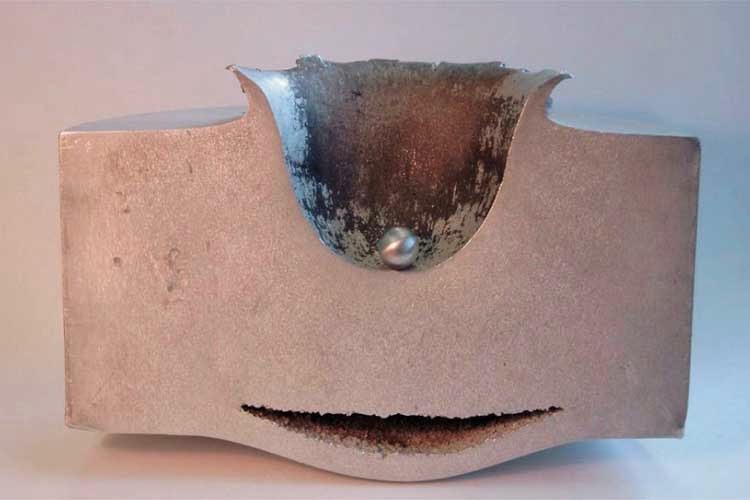
| Yes, this is what happens when a 2.4g aluminium ball hits a aluminium plate with 6.8 km/s relative velocity, ~ 14 kJ impact energy |
As I have noted before major warships are unlikely to have a place in a hard SF military constellation( I prefer, when I remember, to use constellation instead of fleet), but this does not mean that warships are non-existent, and those that do exist, will have to be armed. But in a world where lasers are most commonly found in DVD players, and military units have difficulty taking out fragile missiles, the laser fire that fills the space battles of our imaginations seem no more than dreams. Then to the technology used in your setting might be such that a spacecraft cannot provide power for a weaponised laser. Orion drive spacecraft, for example, are fast and powerful, but need separate electric generators as the drive does not produce power like a fission thermal unit can. Thus if the warcraft are Orion drives or similar, electricity will be at a premium. Other difficulties include the mass and fragility of radiators needed for large amounts of power generation.
The solution is both simple and compacted, but has an unexpected advantage for anyone attempting to portray a realistic space battle in a visual medium. Unpowered kinetic weapons are a must, fuelled by chemical explosives, and self contained missiles and rockets. While such weapons are the staple of ground warfare in the real world, the designs used are unsuitable for space-based applications, although those that can be used in space often can also be used on the ground. Due to the shear size of a space conflict the velocity of a projectile must be as high as possible to increase the chance of a hit, and thus lasers, travelling at the speed of light, are preferred. Fighting with slower kinetic weapons the waring spacecraft must come much closer, making for a more visually dramatic combat. I will look at several systems, and some examples, both real and otherwise, of weapons that can be used without power supplies in a SF military, both in space and on the ground.
![]() |
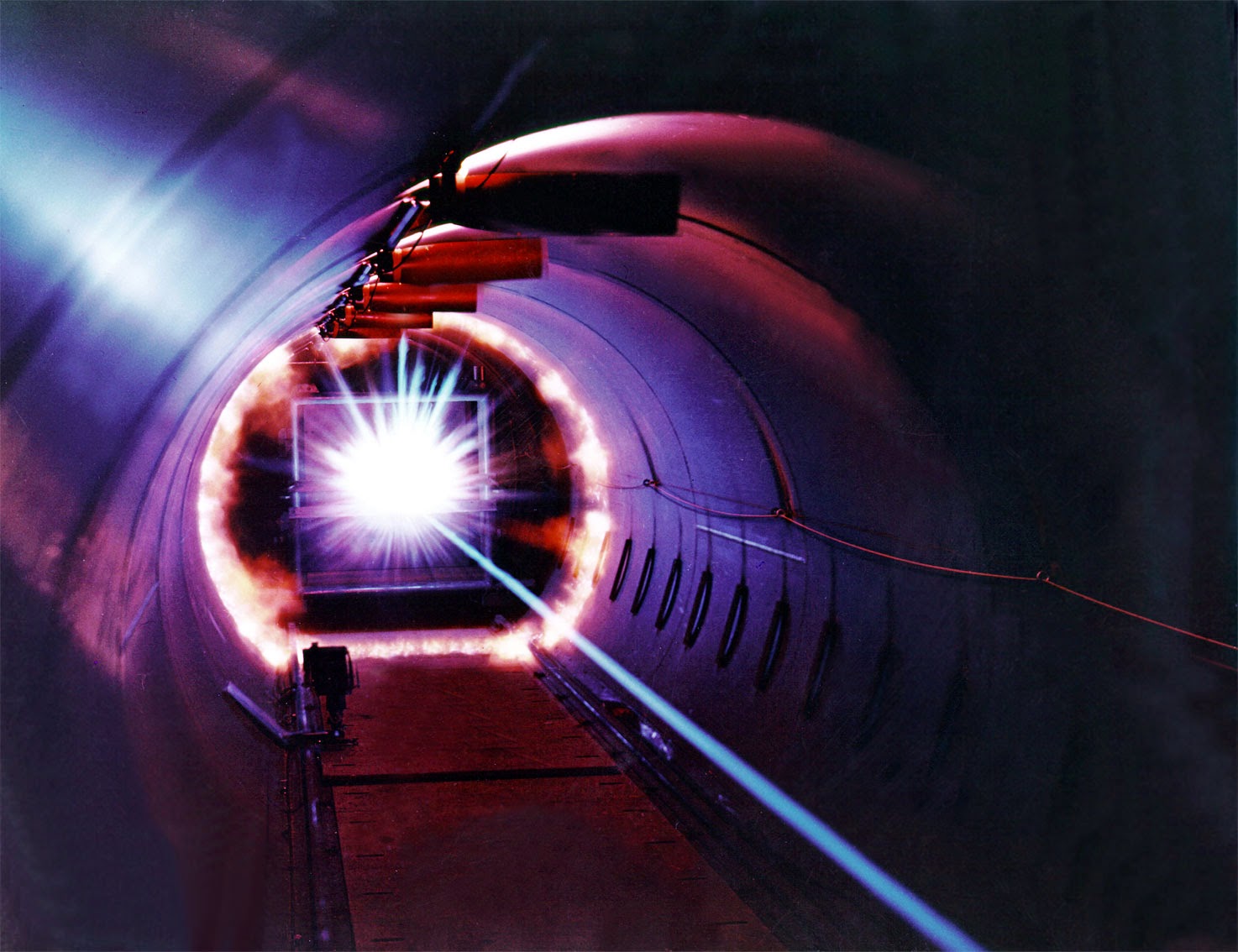
| The friction trail and impact flash of a HV kinetic projectile similar to the one in the previous picture. |
One of many factors limiting the muzzle velocity, and thus effective range, of any conventional gun is the speed of sound in the propellant. A light gas gun, or LGG, bypasses this problem by using a gas with low molecular density, such as hydrogen or helium with a speed of sound several times greater than in air. This can give muzzle velocities of up to 8 km/s as opposed to the 1-2 km/s of a conventional gun. Because the hydrogen or helium working fluid cannot itself provide the energy to fire a small amount of conventional propellant is used, although an electric arc is another possibility, and offers weight savings if the power is available. In a third variant the hydrogen is combusted with a small amount of oxygen, and this type is the combustion light gas gun. In the most common type the conventional explosive is detonated behind a piston, super-compressing the working fluid until the pressure ruptures a membrane between it and the projectile. As the barrel has a narrower bore than the piston the working fluid is accelerated, propelling the projectile out of the barrel.
![]() |
| Image from Wikipedia page on Light Gas Guns |
The Ram Accelerator
Like the LGG the Ram Accelerator is used for research purposes, and is being looked at as a method of non-rocket space launch, shooting one ton cargoes into LEO several times per day at a very low cost. In operation it acts like a scramjet, as shown in the picture to the left, allowing for continuous acceleration along the length of the barrel. Unlike the LGG the muzzle velocity is not limited by the speed of sound, although a hydrogen/oxygen gas mixture is used. Velocities stained are likely to be similar to a LGG, but there is a possibility of higher speeds than the LGG can ever reach.
Although the LGG can be scaled down, the Ram Accelerator is likely to have a fairly large minimum size, offset by the fact it is easier to build a large Accelerator as the barrel is a simple metal tube with relatively low stresses combated to a LGG. A Ram Accelerator is thus suited as the main weapon of a vehicle, perhaps as a spinal mount, or a long ranged bombardment weapon on the surface of a planet. Like a Combustion LGG the fuel is hydrogen and oxygen, easily extracted from water, and so likely to be available in any location throughout the solar system. Payloads can be up to a ton, allowing rounds to carry loads such as guided missiles, nuclear warheads, or others.
Missiles
Missiles, self targeting, self powered, long ranged and deadly, have a lot to offer in space combat. While laser point defence may render them useless in a purely kinetic battlefield they are are force to be reckoned with. Longer ranged missiles may be field by liquid propellants, and carry submunitions or smaller missiles, and be used to open an engagement from long range, while smaller rockets are used as point defines and close quarters weapons. They are far to varied a field of weaponry to do justice to without a full blogpost dedicate to it, so I will only make a few points. The first is that in the majority of cases, as I have said before, no warhead will be needed. The second is that bigger is not necessarily better. The Sprint Anti-Ballistic Missile, built during the cold war, massed out at 3500 kg, could accelerate at 100g, and had a top speed of mach 5 in atmosphere. A space based version would be deadly as a point defines system, or as a close quarters weapon. At this level of technology the only plausible torch missiles are stripped down orion drive spacecraft, basically just and engine unit. These could accelerate at thousands of g, and have impact energies of gigatons, acting as cross system ship-killers.
As an aside, the fabled Gyrojet weapon may have been an failure in its original iteration, but advanced designs or more research could turn it into an effective futuristic weapon, either as a sidearm or a mounted weapon. It has the advantage of almost zero recoil, which is a obvious advantage when fighting in free fall, and also masses less than a conventional small-arm.
Other Options
Although not strictly falling under the heading of this blog are nuclear weapons. Although conventional nuclear explosives are virtually useless in space, nuclear shaped charges or bomb pumped lasers may well rule the battlefield. These will form the subject of a future post, after I have completed the Kelvin deigns, and several other posts of a non-military nature.
Note from the author
This is the first post for a while, and my schedule has been coming apart at the seems, so sorry to anyone who was expecting new posts sooner. They should be more regular from now on, and I have made Friday the update day, starting next week. I also intend to start posting my own SF writing on the blog, both short stories, and analysis of settings, to illustrate the concepts that play into world-building. That should start in a few weeks. Another possible addition is the inclusion of free Blender 3D meshes of spacecraft parts and components for downloading, if I can get blogger to allow it. If not, I will find some other place to put them, and include links. Meshes will mostly be small components like airlocks, docking rings, engines, truss sections, and radiators.
Subscribe to:
Posts (Atom)